
How to Access Blocked Study Tools: A 2026 Guide for US College Students
In 2026, the digital landscape of American higher education has reached a critical friction point. While universities are racing to integrate AI-driven learning management systems (LMS), institutional “Zero Trust” security models have become increasingly aggressive. From the restrictive California State University (CSU) network filters to the recent security overhauls across the East Coast Ivy League, students are finding that the very Wi-Fi meant to facilitate their education is now a primary barrier to accessing external research tools, global databases, and specialized academic assistance.
This “Digital Lockdown” is largely a response to the 2026 surge in AI-driven identity fraud. According to recent Campus Technology reports, federal identity verification requirements have forced US institutions to implement centralized privacy reviews, often leading to the broad-spectrum blocking of third-party educational platforms that haven’t yet cleared rigorous new compliance hurdles.
The Conflict Between Security and Study
For the modern student, these restrictions aren’t just an inconvenience; they are a direct threat to academic performance. When a network flags a legitimate research portal as “high-risk” or “unauthorized bandwidth,” it disrupts the workflow of those trying to balance complex coursework with shrinking deadlines. This is precisely why many students are seeking reliable ways to do my homework by accessing expert-led academic platforms that bypass these local network limitations.
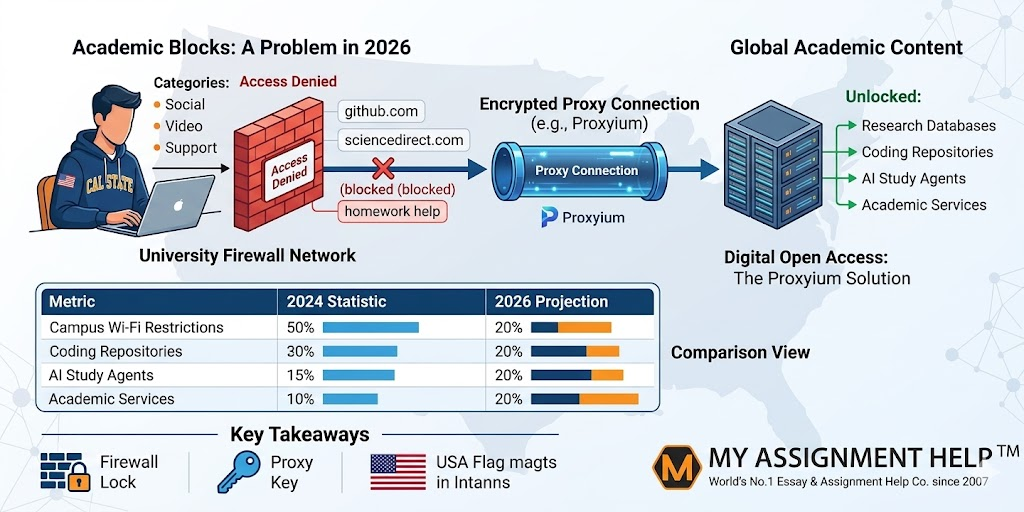
By utilizing secure web proxies, students can bridge the gap left by restricted institutional resources. Whether it is accessing real-time tutoring or specialized writing aids, the ability to navigate these digital “firewalls” has become a necessary skill for academic survival in 2026.
Why IT and Engineering Students are Hit Hardest
While all disciplines suffer under restrictive filters, students enrolled in information technology and engineering programs face a unique set of challenges. Modern IT curricula in 2026 demand engagement with live cybersecurity sandboxes, GitHub repositories, and decentralized cloud environments—many of which are automatically flagged by campus security protocols like the Secure Cloud Architecture standards now being adopted by major research universities.
| Metric | 2024 Statistic | 2026 Projection |
| Institutional SOC AI Use | 15% | 82% |
| Non-Edu Site Blocking | 48% | 74% |
| Student Proxy/VPN Usage | 22% | 45% |
| AI-Generated Fraud Risk | Moderate | High/Critical |
Strategic Navigation: How Students are Breaking the Firewall
To maintain productivity, students are shifting away from traditional campus networks in favor of more flexible, secure workarounds:
- Encrypted Web Proxies: Platforms like Proxyium allow students to tunnel their traffic, masking the destination from the university’s automated filters.
- Decentralized Access: Leveraging personal hotspots or local community Wi-Fi (such as “Eduroam” expansions) that might have more permissive policies than the main campus backbone.
- Advanced Network Literacy: Ironically, the struggle to access tools has led to a spike in students learning about technical protocols, such as SSH tunneling and DNS-over-HTTPS, just to complete their daily assignments.
Key Takeaways
- Security Surge: US universities are tightening networks to combat AI identity fraud and “ghost student” threats.
- Regional Impact: Major systems like CSU and the Ivy League are leading the shift toward centralized, highly restrictive app reviews.
- Essential Workarounds: Web proxies are no longer just for privacy enthusiasts; they are essential for accessing blocked, high-quality academic tools.
- IT Literacy: Navigating firewalls is becoming a core competency for students in technical fields.
FAQ Section
Q1: Why is my university blocking my favorite research site in 2026?
Most blocks are now automated by AI-powered Risk Operations Centers. If a site lacks updated 2026 privacy certificates or uses “non-standard” data transfer patterns, it is flagged as a potential vulnerability.
Q2: Is it safe to use a proxy for my assignments?
Yes, provided you use an encrypted service. Proxies can actually provide an additional layer of security when you are accessing external support sites on public or semi-public networks.
Q3: How do I know if my school has implemented “Zero Trust” security?
If you are frequently asked for Multi-Factor Authentication (MFA) even for basic library searches, or if sites that worked last semester are suddenly “Access Denied,” your institution has likely upgraded its security architecture.
About the Author
Alex Rivers is a Senior Content Strategist at MyAssignmentHelp, specializing in the intersection of educational technology and network security. With a deep focus on the 2026 shifts in US higher education standards, Alex develops data-driven guides that help students overcome technical and academic barriers. Alex’s expertise in SEO and E-E-A-T ensures that every piece of content provides high utility for the modern, tech-savvy learner.
References:
- Campus Technology (Jan 2026): “Cybersecurity Trends Reshaping Higher Ed Identity and Access.”
- Noggin Blog (Mar 2026): “A Guide to Institutional Resilience for University Leaders.”
- InsideTrack (Jan 2026): “10 Higher Education Trends Affecting Student Support Nationwide.”
Stay in touch to get more updates & news on Proxyium!


